
For Ada Lovelace Day, we spoke with Madhu Gupta, Mehika Manocha, and Breana McHugh about the women who paved the way, and what they'd pass on as AI changes who gets to build
This story first appeared on the Xero Developer blog, where we share what’s happening across Xero’s developer community.
Madhu Gupta still remembers sorting through old punch cards as a child.
She remembers being in the computer lab as her mother programmed. Her mother would hit submit, and the machine would spit out the punch cards that held her program. Those went into the computer, which printed its results onto perforated paper.
Decades later, Madhu tells the story over a video call from her bright living room one afternoon. She speaks about her mother with open admiration. "You watch Hidden Figures, and that's the era that my mom worked in," she says. "Where was the women's bathroom?"
Her mother came to computing the long way. In the 1970s, she earned three degrees: a bachelor's in mathematics, then a master's in mathematics, then, after marrying and having children, a master's in aerospace engineering at Michigan. Computer science was still so new that few universities offered it as a degree.
Ada Lovelace Day exists to celebrate women like Madhu's mother. It's named after the mathematician who, in 1843, wrote what is widely regarded as the first computer program, for a machine that was never built, and who saw that such a machine could one day do far more than calculate.
Xero is full of women building and leading in tech today. So this year, to mark the day, we spoke with three of them: Madhu, who leads Xero's ecosystem; Mehika Manocha, a lead engineer who co-chairs Xero's Tech Diversity Network, one of our employee-led communities; and Breana McHugh, who leads the API support team developers turn to when they get stuck. The calls spanned three time zones: Madhu in California's Bay Area; Mehika in Melbourne, Australia; and Breana in Wellington, New Zealand. We wanted to celebrate what they've built, hear about the women who shaped them, and ask what they'd pass on to the next generation.
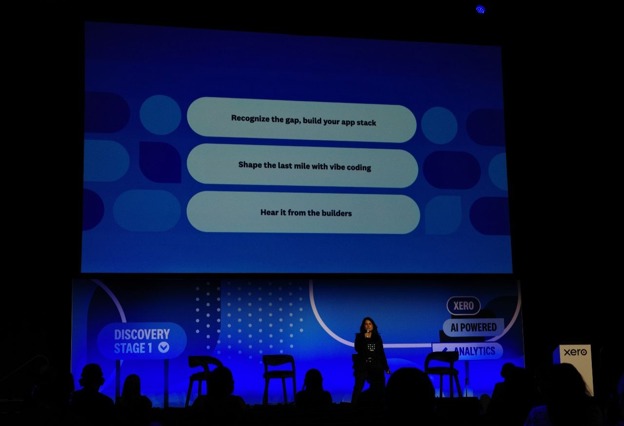
Madhu Gupta, General Manager, Ecosystem, speaking at Xerocon Denver 2026
Why their voices matter: who gets to build is changing again
Who gets to write a program has changed many times. Ada Lovelace was the first person to do it, in 1843. Madhu's mother did it on punch cards, in the generation that made it a career. At Xero Developer, we've been watching AI open the door to anyone with an idea for an app, a tool, or a prototype. We call it the rise of the builder. But a wider door has never meant everyone walks through it equally. Research from Harvard Business School, pooling 76 studies and more than 300,000 people, found that men are around 22% more likely to use generative AI than women.
That gap matters because the people using these tools today will shape what gets built with them tomorrow.
For Madhu, the gap is close to home. She has two daughters, 24 and 21, "in that phase of figuring out their careers". "This is real in terms of family conversation," she says.
It isn't a gap any one person can close. But each of the three women we spoke to has walked through a door that wasn't open wide when she reached it, and each now holds one open for someone else. That's why we asked them what they'd pass on. Their stories kept coming back to three things: the people who showed them it was possible, the people who pushed them when it counted, and the tools that now make it easier to try.
Someone showed them it was possible: a mother, a supervisor, a manager
Madhu had her mother. Watching her, Madhu says, “just inherently showed me that anything’s possible. Just go do it. Don't need to ask permission." She has since spent nearly 25 years building platforms at companies like SAP Labs, eBay, LinkedIn, and Square, and joined Xero three years ago to lead its ecosystem, where part of the job, as she puts it, is "building a platform for other builders to use and build on." There were times she was the only woman in the room. "I just kept going, because I fundamentally found the work that I was doing so interesting."
Mehika joins the call one morning from Xero's Melbourne office, more than eight years after she started as an intern in Canberra. Today she's a lead engineer on the team bringing Syft into Xero. When she talks about her honours thesis supervisor at the Australian National University, she still sounds grateful. That supervisor backed her to build an app for the early detection of Parkinson's disease when Mehika wasn't sure she could. She thinks a lot of women know that feeling. "The reason I was able to do it," she says, "was that support, that extra push: 'Hey, I've got you. We'll get through this together.'"
Breana's path was the least direct of the three. She tells it from her home office late one afternoon, steady and unhurried, as though each unexpected turn led naturally to the next. She went to an all-girls school where "there was one person in the entire year group" who chose tech as a subject in their final year. Breana went on to study management and commercial law. Her first job out of university, summer work migrating a database, pulled her in. "I was like, I don't know SQL, and they're like, okay, we'll teach you." After a run of help desk, support, and development roles, she joined Xero’s API support team six years ago, hired by the manager whose seat she now fills. Breana says that the manager showed her "that you need to be a really good empath as well, and listen to the team."
Someone in their corner: why sponsors matter more than mentors
Mehika calls what her supervisor did sponsorship. "It's not necessarily that women need more mentors," she says. "They need more sponsors." A mentor gives advice. A sponsor uses their own voice on your behalf, in the rooms where decisions get made. And it doesn't take many. "I always tell women that it doesn't have to be a lot of people," she says. One person in your corner can be enough, and that person doesn't have to be a woman. "It's okay to have allies as men," she adds, "because I've been in rooms where there is no other woman. Who do you look up to, because all your leaders are men?"
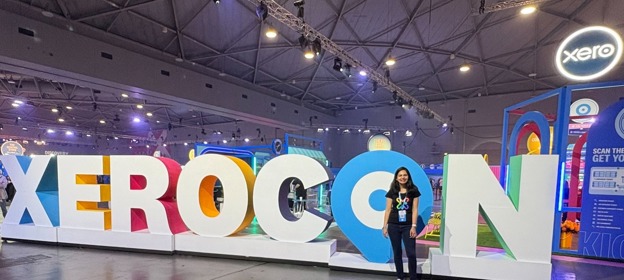
Mehika Manocha, Lead Engineer, at Xerocon Brisbane 2025
Madhu and Mehika are now in other people’s corners, in different ways.
Madhu looks for the people who aren't speaking up. "I'm always looking out within my team for people who are extremely talented, any gender, where I might sense some hesitation, or I might sense that they didn't speak up in a meeting, but I know that they have great ideas." She reaches out to those team members directly, so they know their work has been seen.
Mehika co-chairs the Tech Diversity Network because of a gap she sees at many companies: they're good at hiring for diversity, and less practised at supporting women once they're there. She wants the network to be a space "so people can reach out to me if they need that", for the moments when someone needs to say: "Hey, I'm struggling with this."
Not everyone has a sponsor on day one. There's now another way to test an idea before you have to defend it in a room.
Now it's easier to try, but the ideas still have to be yours
"I was not, and still am not, a very confident person," Breana says. "I've had to learn that confidence." And she has. "Me, I'm loud, because I know you have to be loud and say these things to get traction. But a lot of people won't be confident enough to do that."
In her first week leading the team, she had ideas and no idea where to start. "I was like, okay, this is scary. I'm going to have to talk to all these people. So I just went to Claude and was like, 'Hey, these are some ideas I've got. Is this possible?'"
She could ask it anything. "It's not going to judge you," she says. "I quite often have said to it, 'What are you talking about? This makes no sense to me.' And it will take you through it step by step."
She describes what came next as peeling an onion: ask one question, and it surfaces the next layer of the problem. After six years in the team, she knew which issues customers kept hitting, but "you don't really have that data to back you up." So she built a dashboard of the most common customer questions and pain points and took it to the product teams. One of the top five already has a fix shipped or on its way.
Now she's pushing her team towards the same tools. "We've got the budget to work with Claude. We've got all these tools at our disposal. Just use them." Even for small things: "Even if it's just a tiny little dashboard for yourself where you just want to track your own stats, it doesn't need to be something that you share publicly."
Madhu sees AI changing how her own teams share ideas. "AI is definitely creating opportunity for essentially anyone to become a builder," she says. "What is now becoming that critical unlock is: do you have an idea?" Prototyping has become a shortcut to self-expression. "It's given everybody a new voice, almost like a new channel for sharing ideas. You can actually just prototype something and say, 'Hey, I have this idea. It literally took me five minutes to vibe code, but I want to visualise it for you and show you.'" Before, an idea had to survive a document. "How many people read documents?"
The prototype comes faster now. The idea still has to be yours.

Breana McHugh, API Support Team Lead
It took Breana a while to come around, for a reason anyone who went through school will recognise.. "It's always drilled into you to not plagiarise. Work has to be your own. And the way I saw it was, oh my god, this feels lazy to me in a way." That changed with use. "No, they are my ideas. It's just enhancing it." The first document AI wrote for her was "very corporate", full of things she "would never say", so she shaped it until it sounded like her.
Mehika takes it further. "I like to think that AI doesn't replace the fundamentals, just raises the stakes," she says. "The non-functionals are more important now than ever." Non-functionals are the things users never see but always feel: security, reliability, performance. She's also one of Xero's security champions, advocating for security across teams. Security is only one of the fundamentals she wants people new to the industry to learn not to take for granted.
AI can make a voice louder. It shouldn't decide what that voice has to say.
Closing the gap: their advice for your first build
Let's go back to the Harvard research. Its authors also looked at why the gap exists. Women report knowing less about the tools, feeling less confident using them, and worrying more that using AI will be seen as cheating or a sign of low ability. You can see parts of all three in Breana's journey into tech and AI from a non-technical start, and many women will recognise them. There are other reasons too, including stronger concerns about data security. The three women's advice, when we asked what they'd tell a woman about to build something for the first time, speaks to these concerns.
-
Start with a problem you already have. "Take something you do day to day and try and automate it," Mehika says. "You already do the task, you understand the pain of the task." Her advice is to start with "a small problem in your day-to-day life", not a big project.
-
Start small, and don't do it alone. "Don't be afraid to ask for help, or get someone to work on it with you," says Breana. "Start off small, and then start building your way up."
-
Use the time before your limits are set. "The nice thing about being early in your career is your assumptions and your limitations are not cemented yet," says Madhu. Her advice: try things, and share what you build.
-
Stay curious. "'I don't know how this agent works, but I'm going to find out,'" Mehika says. "That helps demystify some of the black boxes."
More than one day: taking Ada Lovelace Day into the rest of the year
Mehika has a line she comes back to every Ada Lovelace Day. "Women don't actually need things like cupcakes. Cupcakes are great to celebrate, but we just need to stop and celebrate women." The day, for her, is a chance to say: "If she can do it, you can do it."
She's equally clear that one day isn't enough. "Creating an event is the easy bit," she says. "How do I take that to make it more consistent across the organisation, just so we see it every day, is the challenge."
The Tech Diversity Network runs a couple of events each year, for women inside Xero and out. On Thursday 8 October, it partnered with She Sharp and Secure Code Warrior on Beyond the Code: Women Leading the Future of Cybersecurity and AI. From 5pm, women and female-identifying people, from first-timers to security professionals, brought their laptops to Xero’s office in Parnell, Auckland. The evening opened with a panel on the critical role of cybersecurity in AI, with Mehika among the speakers. Then, for 45 minutes, attendees raced a clock and a leaderboard to find the flaws in real vulnerable code and fix them, in Java, Python, JavaScript, Ruby, or pseudocode for anyone who didn’t want to pick a language.
More than 180 years after Ada Lovelace wrote the first program, and decades after Madhu watched her mother’s programs come out on punch cards, a room of women in Auckland spent a Thursday evening securing real code. The tools look nothing like they did then. The lesson Madhu learnt from her mother still holds: “Just go do it. Don’t need to ask permission.”


